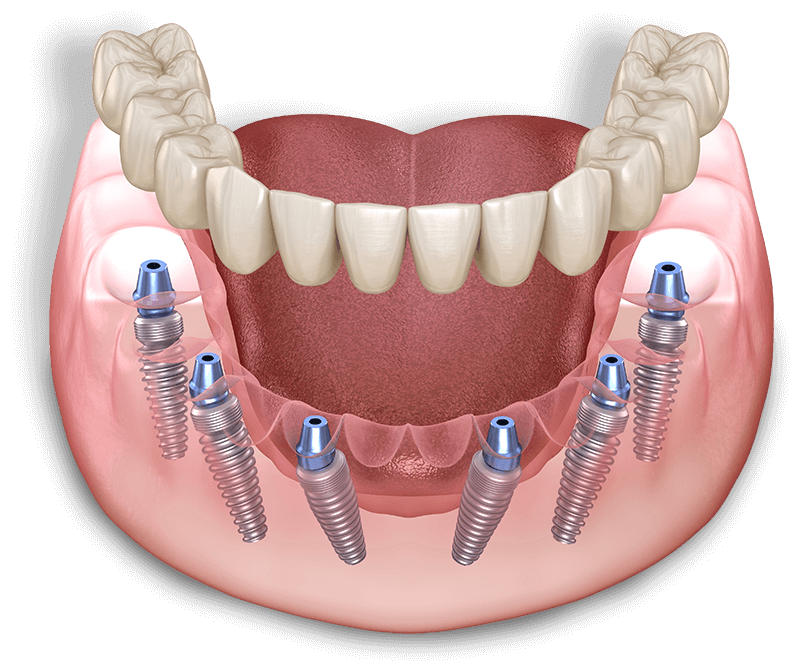
Severe bone loss does not automatically mean a patient cannot have full-arch dental implants. It does mean the treatment plan needs to account for where usable bone remains, how the implants can be distributed, whether grafting is appropriate and whether the final prosthesis can be supported predictably.
The important question is not simply, “Do I have enough bone?” It is: Do I have enough bone in the right locations for the restoration we are trying to build?
Why Bone Is Lost
Jawbone can diminish after tooth loss because the bone is no longer receiving the same functional stimulation. Periodontal disease, infection, trauma, long-term denture wear and individual anatomy can also contribute to bone loss.
Does Severe Bone Loss Always Require Grafting?
No. Some full-arch treatment concepts are designed to use the patient’s existing bone efficiently, including angled implant placement when appropriate. In other cases, grafting may improve implant position or make the restorative plan more predictable.
The decision should be based on anatomy and prosthetic goals rather than a promise to either always graft or never graft.
Why Implant Position Matters More Than Implant Count
A full-arch prosthesis needs a useful distribution of support. Simply placing a certain number of implants does not guarantee that the final bridge will have appropriate support, cantilever, screw access or hygiene space.
See how implant number and distribution are selected for a full arch.
How CBCT Imaging Helps
Three-dimensional CBCT imaging allows the clinician to evaluate bone volume, ridge shape, sinus anatomy, nerve position and possible implant trajectories before surgery. This is especially important when bone is limited and there is less room for error.
Learn more about CBCT imaging for dental implant planning.
What About the Upper Jaw?
The upper jaw often presents different challenges than the lower jaw because bone quality and sinus anatomy may limit available implant positions. The amount and location of remaining bone can influence whether implants are placed in conventional positions, angled, grafted or treated with another approach.
Can Bone Reduction Be Part of Full-Arch Treatment?
In selected cases, bone reduction may be used to create restorative space, establish a more favorable transition line or provide the prosthetic dimensions needed for the final restoration. This is very different from grafting: one adds or preserves bone, while the other intentionally reshapes it as part of the prosthetic plan.
When Might a Different Treatment Be Better?
If the available bone, restorative space, medical risk or hygiene considerations make a fixed full-arch restoration unfavorable, a removable implant-supported prosthesis may be a better solution.
Compare snap-in dentures vs. All-on-X.
Can Bone Loss Affect Immediate Teeth?
Yes. Immediate provisional teeth depend on adequate implant stability and distribution. If the available bone does not allow the implants to achieve the stability needed for immediate loading, protecting the implants during healing may be safer than forcing a same-day fixed restoration.
How We Evaluate Severe Bone Loss
At ABC Dental Care in Las Vegas, John Walker, DDS evaluates bone, anatomy and prosthetic design together before recommending a full-arch plan.
Review our All-on-X full-mouth implant treatment and All-on-X candidacy considerations.
Bottom Line
Severe bone loss can make full-arch treatment more complex, but it does not automatically rule it out. The plan should be based on three-dimensional anatomy, implant distribution and the needs of the final prosthesis.