

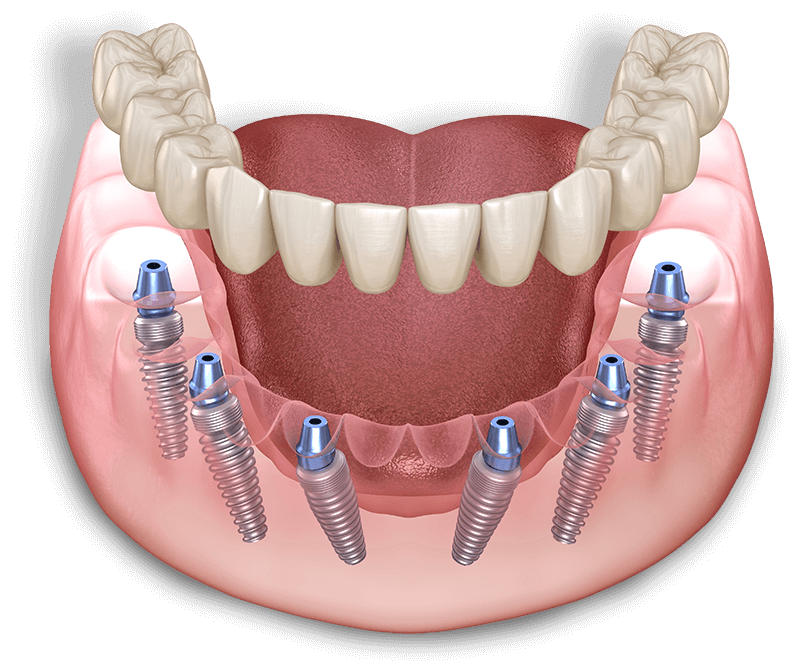
Patients considering full-arch dental implants often ask whether they need four implants, six implants or some other number. The answer is not based on a universal formula. The appropriate number of implants depends on the patient’s anatomy, available bone, implant distribution, bite, prosthetic design and long-term maintenance needs.
In other words, the goal is not to use the fewest implants possible or the most implants possible. The goal is to create a stable, maintainable foundation for the planned full-arch restoration.
Why Do Some Full-Arch Cases Use Four Implants?
Four implants can support a fixed full-arch restoration in appropriately selected cases. This concept is often associated with All-on-4 treatment, where implant positions are planned to provide useful front-to-back spread and avoid certain anatomic limitations.
For some patients, four well-positioned implants can provide an effective foundation. For others, anatomy, bone quality, restorative design or risk considerations may support a different plan.
Why Might a Full Arch Use More Than Four Implants?
Additional implants may be considered when they meaningfully improve the restorative plan. Possible reasons include:
- available bone allows a broader distribution of implant support;
- the arch shape or restorative span benefits from additional support;
- the opposing dentition creates substantial functional forces;
- the prosthetic design would benefit from a different implant configuration;
- the clinician is planning around specific anatomic or mechanical concerns;
- future restorative flexibility is an important consideration.
More implants are not automatically better. Each implant should have a clear surgical and prosthetic role.
Why Isn’t Implant Count Chosen From a Package?
A full-arch restoration is a prosthetic reconstruction supported by implants. The implant positions must therefore work with the final tooth position, bite, smile line, restorative space and hygiene access.
If the treatment is planned around a predetermined implant count before evaluating the patient, the prosthetic design may be forced to adapt to the implants rather than the implants being placed to support the intended restoration.
What Does All-on-X Mean?
All-on-X reflects this individualized approach. The “X” represents the number of implants selected for that arch according to the clinical situation. That may be four implants in one case and a different number in another.
For a more detailed comparison, see All-on-4 vs. All-on-X.
How Does Bone Quality Affect Implant Number?
Implant stability depends on more than bone quantity. Bone density and quality can influence primary stability, implant selection and loading decisions. Two patients with similar-looking X-rays may still have very different surgical conditions.
Three-dimensional imaging helps evaluate available bone and nearby anatomy before surgery. Learn more about CBCT imaging for implant planning.
Does the Upper Jaw Need More Implants Than the Lower Jaw?
There is no single rule that applies to every patient, but the upper and lower jaws can differ in bone quality, anatomy and restorative mechanics. Those differences may influence implant selection, position and loading strategy.
The number of implants should therefore be based on the actual arch being treated rather than assuming the same design is ideal for both jaws.
What About Immediate Loading?
If a provisional full-arch restoration is planned soon after implant placement, the implants must provide adequate stability and distribution for the intended load. Implant count alone does not determine whether immediate loading is appropriate.
The clinician must also consider insertion stability, bone quality, implant position, splinting through the prosthesis, bite control and the patient’s ability to follow postoperative instructions.
Does More Implants Mean a Better Backup Plan?
Not necessarily. A full-arch prosthesis is a system. If one implant develops a problem, the impact depends on which implant is involved, the overall distribution, the prosthetic design and the condition of the remaining implants.
Planning should account for possible complications, but simply adding implants without a clear restorative purpose is not a substitute for sound design and maintenance.
Read more about evaluating a failing or compromised dental implant.
What Other Factors Matter Besides Implant Count?
Some of the most important full-arch planning factors include:
- prosthetic space;
- smile line and lip position;
- bone reduction requirements;
- anterior-posterior spread;
- cantilever length;
- restorative material;
- hygiene access;
- parafunction and bite forces;
- opposing teeth;
- medical and healing factors.
Can a Snap-In Denture Use Fewer Implants?
Removable implant overdentures and fixed full-arch restorations are different prosthetic designs with different support and maintenance requirements. The implant plan for a snap-in denture should not simply be copied from a fixed All-on-X plan.
See our comparison of snap-in dentures vs. All-on-X.
How We Decide Implant Number
At ABC Dental Care in Las Vegas, John Walker, DDS evaluates the surgical and restorative plan together. Implant count is selected after considering anatomy, bone, implant distribution, the final prosthesis, function and maintenance—not from a predetermined package.
You can review our All-on-X and full-mouth implant treatment, implant cost and financing information, and before-and-after treatment examples.
Bottom Line
A full arch does not automatically require four, five or six implants. The correct number is the number that best supports the planned restoration for that patient’s anatomy, function and long-term maintenance needs.