
Full-mouth dental implant treatment is not simply a matter of placing several implants and attaching teeth. It is a comprehensive surgical and restorative treatment that requires planning the bone, implant positions, bite, prosthesis, cleansability, esthetics, and the patient’s long-term maintenance before surgery begins.
At ABC Dental Care in Las Vegas, Dr. John Walker evaluates full-arch cases from both the surgical and restorative perspective. The objective is to build a stable foundation for a fixed implant-supported prosthesis while designing teeth that function appropriately for the individual patient.
Who may be a candidate for full-mouth implants?
Full-arch treatment may be considered for patients who are missing most or all of the teeth in an arch, have a failing dentition that cannot predictably be restored, or are struggling with removable dentures and want to explore a fixed solution. Candidacy cannot be determined from the number of missing teeth alone.
Important factors include available bone, periodontal condition, smile line, lip support, bite, parafunctional forces, medical history, nicotine use, oral hygiene, and the space required for the prosthesis. 3D CBCT imaging for dental implants is often an important part of evaluating the anatomy and planning implant positions.
How many implants are needed for a full arch?
There is no single implant number that is correct for every patient. The number, position, angulation, distribution, and stability of the implants all matter, as does the type of final prosthesis. Full-arch concepts commonly use multiple implants distributed across the arch, but the final plan should be based on the patient’s anatomy and restorative requirements rather than a marketing formula.
When bone volume is limited, treatment may require modification of implant position or additional procedures. In some situations grafting may be appropriate; in others a different implant or prosthetic strategy may be considered. Our overview of dental implant risks and treatment considerations explains why individual risk factors matter.
Can teeth be placed the same day?
Some patients can receive a fixed provisional prosthesis on the day implants are placed. This is often called immediate loading or same-day teeth. It is not automatic. Adequate implant stability, favorable distribution, the planned bite, the condition of the surgical sites, and the patient’s risk factors must support that decision.
The same-day prosthesis is generally a provisional restoration used during healing. After the implants and tissues have healed, the case is reassessed and the definitive prosthesis is fabricated according to the treatment plan. Patients receiving immediate-load treatment should follow the dietary and hygiene precautions discussed in our dental implant aftercare and healing guide.
Why the restorative plan should come before implant placement
In full-arch dentistry, implants should be positioned to support the planned teeth—not simply placed wherever bone happens to be easiest to access. Before surgery, the clinician has to think about where the teeth need to be, prosthetic space, screw-access position, tissue contours, cleansability, anterior-posterior implant spread, and how chewing forces will be distributed.
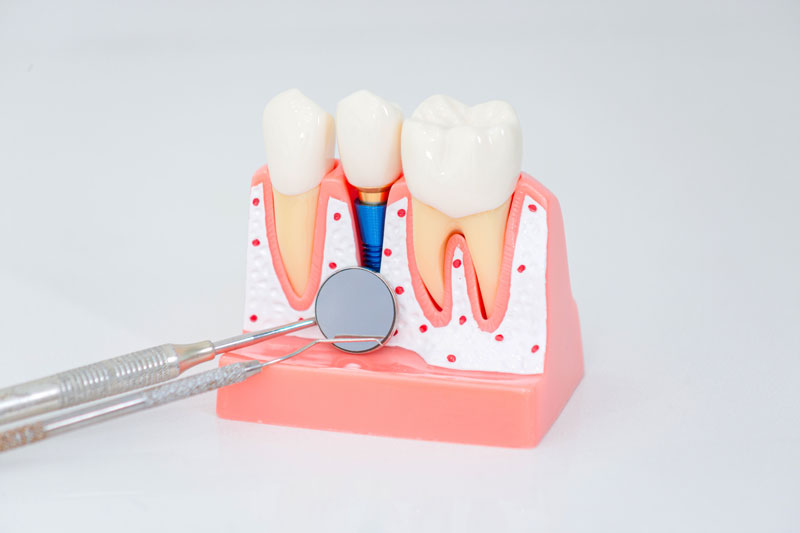
This prosthetically driven approach is particularly important because a technically integrated implant can still create restorative problems if it is poorly positioned for the final prosthesis. Multi-unit abutments and other implant restorative components can also play an important role in creating the prosthetic platform for a fixed full arch.
What patients should expect after treatment
Full-arch implant treatment requires maintenance. Patients need to learn how to clean underneath and around the prosthesis and should return for professional evaluation at an interval appropriate for their periodontal and implant risk. The dentist may periodically evaluate the prosthesis, implant components, surrounding tissues, bone levels, hygiene, and bite.
If an implant or prosthetic component develops mobility, discomfort or another concern, it should be evaluated rather than assumed to represent complete implant failure. Our guide to failed dental implants and replacement options explains the distinction between restorative complications and problems involving the implant fixture.
Dr. Walker’s post-graduate implant training includes fellowship training through the California Implant Institute, an implant fellowship through NYU, full-arch implant training, and advanced overdenture education. His implant practice includes single implants, implant-supported overdentures, and full-arch treatment.
If you have been told that your remaining teeth are failing, currently wear dentures, or are considering full-mouth dental implants in Las Vegas, ABC Dental Care can evaluate the available options and determine whether fixed full-arch treatment is appropriate for you. You can also review our broader dental implant treatment options, learn about dental implant cost and financing, or watch full-arch and implant patient stories. Call 702-228-1701 to schedule an implant consultation in Las Vegas.