

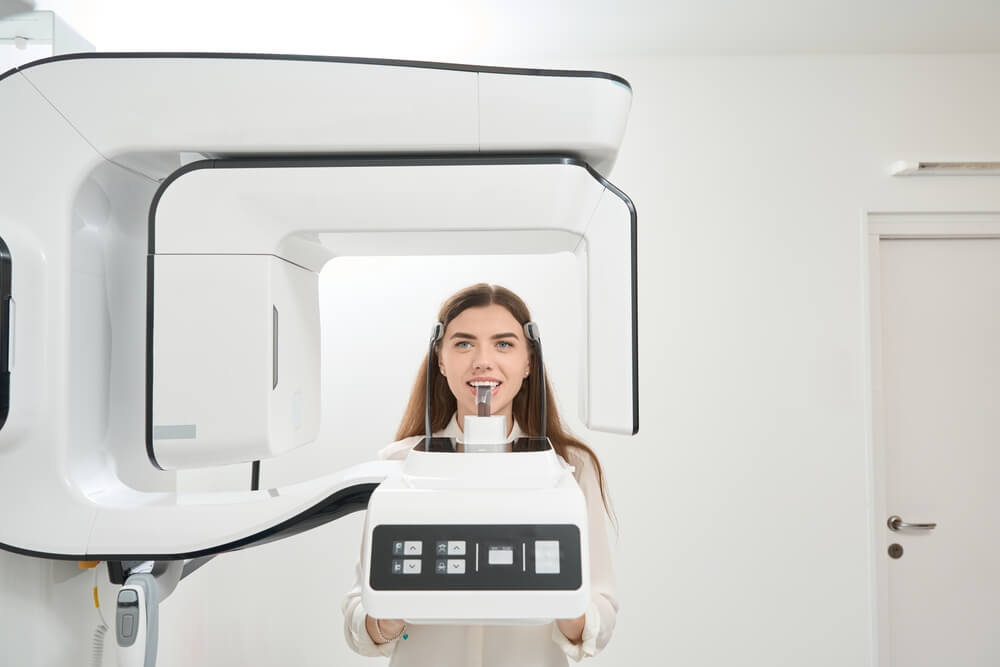
For dental implant treatment, the most useful question is not simply whether there is enough bone for an implant. The goal is to determine whether an implant can be positioned safely and in a location that supports the final tooth or prosthesis. Three-dimensional cone beam computed tomography (CBCT) can provide information that is not available from a conventional two-dimensional dental image alone.
At ABC Dental Care in Las Vegas, Dr. John Walker uses clinical examination and appropriate imaging to plan implant treatment around both the patient’s anatomy and the intended restoration. CBCT may be especially useful when evaluating individual implants, implant-supported dentures, full-arch treatment, bone grafting, or existing implant complications.
What does a dental CBCT show?
A CBCT scan creates a three-dimensional dataset of the teeth and surrounding maxillofacial structures within the area captured by the scan. For implant planning, it can help evaluate the height and width of available bone and the relationship of a proposed implant site to important anatomy.
Depending on the area being evaluated, this may include the maxillary sinus, nasal cavity, adjacent tooth roots, impacted teeth, areas of bone loss, and the mandibular canal associated with the inferior alveolar nerve. The scan can be viewed in multiple planes so the site can be assessed from different perspectives.
Why is 3D imaging useful for dental implants?
An implant ultimately has to support a restoration. That means implant planning should consider more than the surgical site. The position and angle of the implant can affect the emergence of the final tooth, screw-access location, restorative space, cleansability, esthetics, and how chewing forces are distributed.
CBCT information can help Dr. Walker evaluate whether the available anatomy is compatible with the intended restorative position. When appropriate, the scan can also be combined with digital restorative information as part of a prosthetically driven treatment plan.
CBCT and full-arch implant planning
For full-mouth and full-arch dental implant treatment, planning involves the entire prosthetic foundation rather than a single missing tooth. Bone distribution, implant spacing, restorative space, the location of anatomical structures, force distribution, and the design of the provisional and definitive prostheses all need to be considered together.
A CBCT can help identify anatomical limitations before surgery and assist in determining potential implant positions. It does not, however, determine the treatment plan by itself. The scan has to be interpreted together with the clinical examination, dental history, restorative objectives, and other diagnostic records.
Can CBCT help determine whether bone grafting is needed?
CBCT can provide three-dimensional information about the existing ridge and areas of bone deficiency. That information may help determine whether an implant can be placed in the desired restorative position with the available bone or whether grafting, sinus augmentation, an alternative implant position, or a staged approach should be considered.
Imaging is only one part of that decision. Bone quality, soft tissue, infection, healing factors, implant stability requirements, and the type of final restoration can also influence treatment.
Does every dental implant patient need a CBCT?
Not necessarily. Imaging should be selected based on the diagnostic information needed for the individual patient. CBCT uses ionizing radiation, so the expected diagnostic benefit should justify the examination and the scan should be limited and optimized for the clinical task when possible.
CBCT also has limitations. It does not replace a hands-on clinical examination, periodontal evaluation, restorative assessment, or sound surgical judgment, and no imaging technology can guarantee an implant outcome.
Using 3D information to plan the final result
Dr. Walker’s implant training includes fellowship training through the California Implant Institute, an implant fellowship through NYU, full-arch implant training, and advanced overdenture training. His clinical work includes individual implants, implant-supported dentures, full-arch treatment, and evaluation of implant complications.
At ABC Dental Care, the purpose of 3D imaging is not simply to obtain a more sophisticated picture. When CBCT is indicated, the information is used to understand the anatomy and help plan implant placement around the intended restorative result.
If you are considering dental implants in Las Vegas, call ABC Dental Care at 702-228-1701 to schedule an implant evaluation and discuss which diagnostic records are appropriate for your treatment.